

Cross-team processes
Connect a request as it passes from sales to operations, finance and delivery. Carry the agreed details and decisions forward with the work.
Custom Business Automation
Some processes depend on a mix of software, spreadsheets and knowledge held by one person. We build automation around those specific ways of working, including unusual bookings, specialist approvals and cross-team tasks. Start with one process your existing tools do not fully cover, then extend what proves useful.
Talk through your workflowSound familiar?
Built around your operation
The work that makes your business different is often the work standard software does not cover. We build the missing connections around your scheduling, approvals and delivery process.
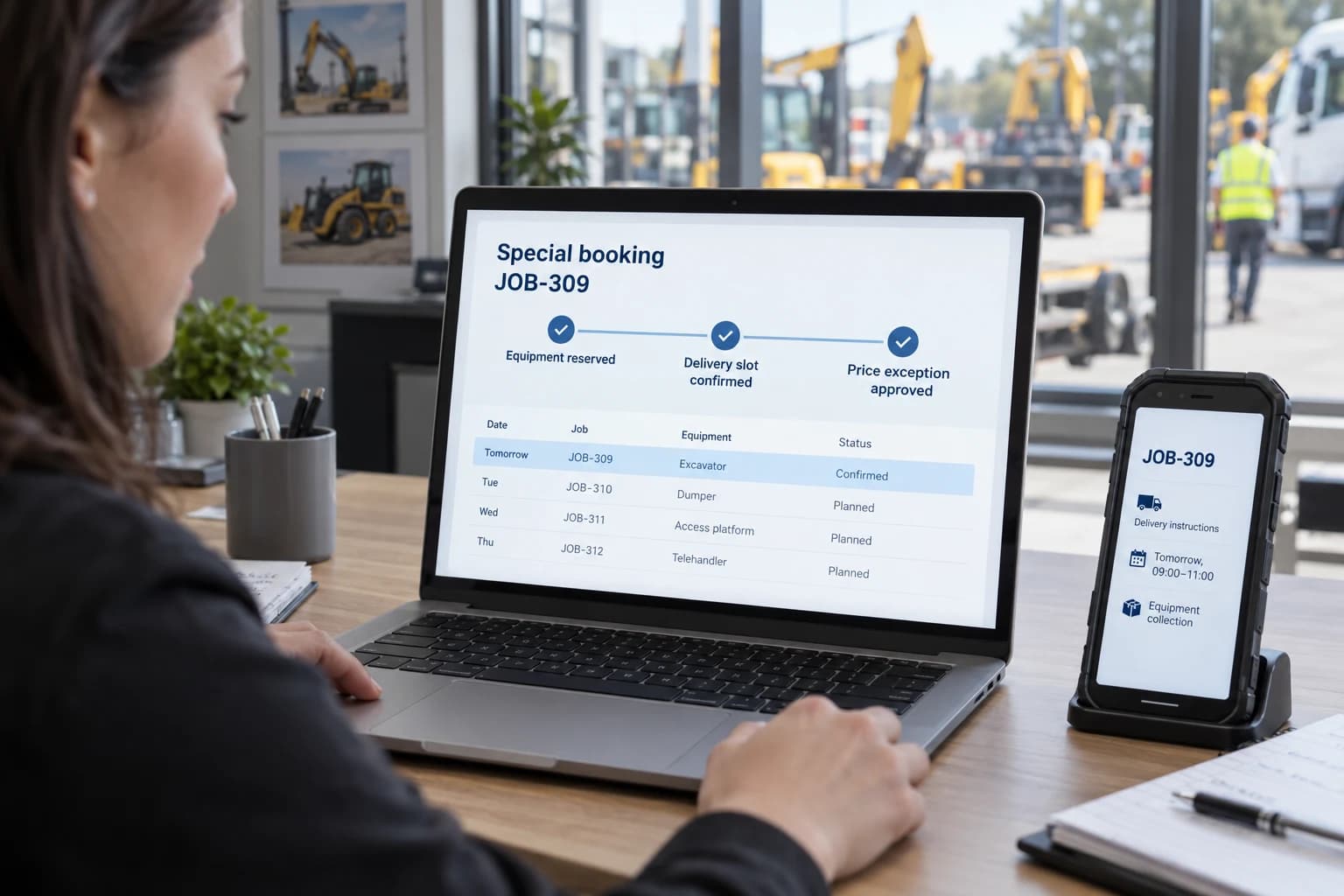
For an equipment booking, that could mean checking availability, obtaining approval for a special price and preparing a complete job for the delivery team. The agreed details travel with the job instead of staying in one person's inbox.
We map one process, check what your current systems support and build around the gaps.
See the difference
Bring the stable steps into a shared workflow and give exceptions a deliberate route to the right person.
JOB-309 · Special booking
Check the request
Confirm availability
Review the exception
Create the agreed job
ReadyThe operations team receives a complete job with the approved scope and customer context.
Non-standard pricing or availability stays with an authorised person.
Where automation can help
A focused starting point can make the next step clearer. These are the areas we can explore around your existing systems.
Connect a request as it passes from sales to operations, finance and delivery. Carry the agreed details and decisions forward with the work.
Handle the conditions that standard tools miss, such as specialist eligibility, unusual pricing or approval by more than one department.
Work with the access your older software provides. Where supported, information can move through a connection or file exchange without replacing the whole system.
Build a simple workspace for reviewing requests, coordinating jobs or resolving problems when your team needs more than a background connection.
One workflow, end to end
A service business receives a booking that needs equipment, a delivery slot and a price exception. The standard booking tool handles only part of the work.
Capture the requested equipment, dates, delivery needs and the reason it falls outside the normal process.
Read availability from the agreed source and prepare possible delivery slots without promising them to the customer.
Give the responsible manager the proposed price and scope. Record the decision and any conditions.
After approval, reserve the agreed resources and give operations one job record with the final instructions.
Potential business impact
Start with the current process. Agree what improvement would look like, then evaluate the workflow against it.
Bring the real process out of individual inboxes and spreadsheets.
Make rules and handoffs visible to the people doing the work.
Adapt the missing steps around tools that already serve the business.
Evaluate one workflow before extending the scope.
Behind the workflow
The technology follows the process: what needs to happen, which systems hold the information and who can authorise the next step.
We follow a real request from start to finish with your team, including the workarounds. That establishes which steps are repeated, who makes decisions and what your existing tools can support.
We connect the information and actions the process needs, using the methods your systems support. If someone needs to review or coordinate work, we build a focused screen for that job.
We test everyday work and unusual cases with your team, document who is responsible and explain how to recover from interruptions. Support and future changes are agreed before handover.
Where this can be useful
Custom Business Automation FAQs
Practical answers about the work, the systems involved, and the decisions your team keeps.
Custom work can be useful when your rules, handoffs, or existing systems leave important gaps that standard tools cannot reasonably cover. We first check whether configuration or a maintained connector would be enough. The decision includes build cost, ongoing maintenance, ownership, and how often the process is likely to change.
Yes, if the responsibilities, inputs, and decision rules can be made clear. We map the handoffs and agree which system owns each record. A first phase can cover one section of the process, with named owners for exceptions, before expanding across departments.
Yes. Some workflows need a focused screen for reviewing requests, coordinating work, or resolving exceptions, alongside the connections between systems. We scope the interface, access roles, backend behaviour, and operating needs together. A full application is not required when a simpler connection solves the problem.
We work through real examples and exceptions with a process owner before building. We identify which rules can be safely configurable and which need a reviewed software change. Frequent changes affect scope and maintenance, so the handover should make ownership and the update process clear.
Our principle is that you own the software built for your business, with source code and documentation included in the agreed handover. We define account access, deployment guidance, and dependencies. Third-party platforms and services keep their own licences, and ongoing support is scoped rather than assumed.
A pilot can focus on one outcome and the minimum connections needed to test it. Cost and timing depend on system access, business rules, interfaces, data preparation, and exception handling. Discovery establishes the scope, acceptance criteria, estimate, and dependencies before a larger delivery commitment.
See how we scope and deliver a pilotNext step
Tell us how it works today, including the workarounds. We'll help you define a focused automation that fits your business and the systems you already use.
Explore your automation idea