Modernization guide / Systems engineering
Legacy system modernization without a big-bang rewrite
How to improve an important old system gradually, protect daily operations, and decide which part of the technology estate should change first.
A legacy system is not necessarily a bad system. It may be stable, deeply connected to the operation, and full of business knowledge that was never written down elsewhere.
The problem is usually that the system has become difficult to understand, change, secure, or operate. A full replacement may sound clean, but replacing a system that carries years of rules and exceptions is one of the highest-risk technology decisions a business can make.
The short answer
Modernize incrementally when the system is important, the business cannot tolerate a long interruption, or the existing behaviour is not understood well enough to replace safely.
Start by mapping the system’s business capabilities, dependencies, data flows, and operational risks. Then choose a small, valuable slice that can be improved, observed, and separated without putting the rest of the operation at risk.
What makes a system legacy?
Age alone is not the test. A newer system can become legacy if it is difficult to change or no longer fits how the business operates.
Common signals include:
- Small changes require disproportionate effort.
- Only one or two people understand important behaviour.
- Integrations depend on manual exports or fragile scripts.
- The system has no reliable automated tests or monitoring.
- Data definitions differ between teams or applications.
- Security updates are difficult to apply.
- The business avoids useful improvements because the risk feels too high.
These are business risks as much as technical risks. They affect response time, operational continuity, customer experience, and the organisation’s ability to adapt.
Why the big-bang rewrite is tempting
A rewrite promises a clean codebase, a modern stack, and a chance to remove years of accumulated complexity. Sometimes a replacement is correct. But a rewrite also requires the team to rediscover every rule, exception, dependency, and operational habit that the old system contains.
The dangerous part is not the new code. It is the unknown behaviour that the new code accidentally changes.
A safer modernization sequence
1. Understand the current operation
Document what the system does in business terms: who uses it, which decisions it supports, which records it owns, and what happens when something fails.
2. Stabilize the foundation
Before changing major behaviour, improve access control, backups, deployment repeatability, logging, monitoring, and the ability to test important paths.
3. Identify business capabilities
Instead of treating the old application as one indivisible block, identify capabilities such as orders, pricing, inventory, scheduling, payments, or reporting.
4. Choose a thin slice
Select a capability that is valuable enough to matter but bounded enough to change safely. The first slice should create learning and reduce risk, not only produce a technical demonstration.
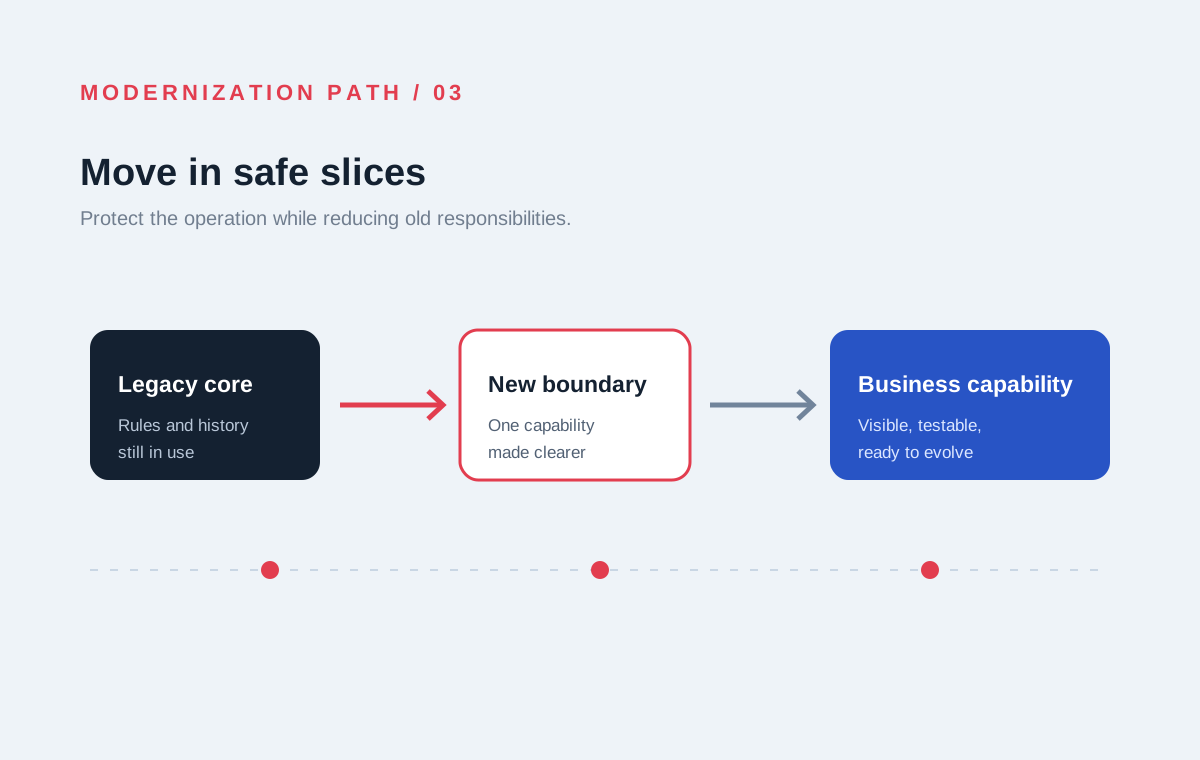
5. Put a clear boundary around the change
An API, event flow, or carefully defined data interface can allow the new capability and old system to work together while the migration continues.
6. Measure and repeat
Track operational outcomes, error rates, support effort, delivery speed, and the confidence of the people using the system. Use what is learned to choose the next slice.
The strangler pattern in plain English
The strangler pattern means gradually placing new capabilities around an old system until the old responsibility can be retired safely.
Imagine an old order system that also handles pricing, inventory, and reporting. Instead of replacing all three at once, the business may first introduce a new reporting capability that reads from a controlled data interface. Later, inventory or pricing can move behind its own boundary.
The old system remains useful while the business reduces its responsibility one capability at a time.
How to choose the first slice
Score candidate capabilities against four questions:
| Question | Why it matters | | --- | --- | | Business value | Does improving this change a meaningful outcome? | | Technical risk | Will it reveal important dependencies? | | Boundary clarity | Can it be separated from the rest? | | Operational safety | Can the change be rolled back or run in parallel? |
The best first slice is rarely the most visible feature. It is often the capability where business value and learning are both high, while the blast radius remains manageable.
What modernization should not mean
Modernization is not automatically:
- Moving the same complexity to the cloud.
- Replacing a database because it is old.
- Rewriting everything in a fashionable language.
- Rebuilding every existing feature without questioning its value.
- Removing experienced operational staff from the process.
Technology changes matter, but they should serve a clearer business capability, lower risk, or better ability to change.
How to measure progress
Useful measures can include:
- Time required to make and release a change.
- Number of manual reconciliations or workarounds.
- Recovery time after a failure.
- Percentage of important workflows that are observable and tested.
- Number of people who can safely support the system.
- Data quality and reconciliation effort.
- Business outcomes for the capability being modernized.
Do not measure only lines of code moved or applications retired. A modernized system that is still difficult to operate has not solved the real problem.
Final recommendation
Treat legacy modernization as a business capability program supported by engineering, not as a technology clean-up project. Protect what the operation depends on, make the current behaviour visible, and move in slices that create evidence.
SystemVale helps businesses assess difficult systems, define safer modernization paths, and improve live platforms without assuming that everything needs to be replaced at once.
Frequently asked questions
Should we replace a system that still works?
Not automatically. The better question is whether its cost, risk, and inability to change are becoming unacceptable for the business.
How long does modernization take?
It depends on system size, dependencies, data, and the pace the operation can safely absorb. Incremental programs create value in stages rather than waiting for one final cutover.
Can old and new systems run together?
Yes, when the boundary, data ownership, synchronization, and failure behaviour are designed deliberately. Running systems in parallel without clear ownership creates confusion.
What should we do first?
Start with an assessment of business capabilities, system dependencies, operational risks, and the people who understand the current behaviour.
A useful next step
Good software decisions start with the workflow, not the feature list.
See how we workNext step
Your legacy system may not need to be replaced all at once.
We can help identify the safest modernization path and choose the first business capability to improve.
Explore a modernization path