
Planning guide / Software investment
How much does custom business software cost?
A practical framework for understanding software project cost before you commit to a scope, a team, or a technology stack.
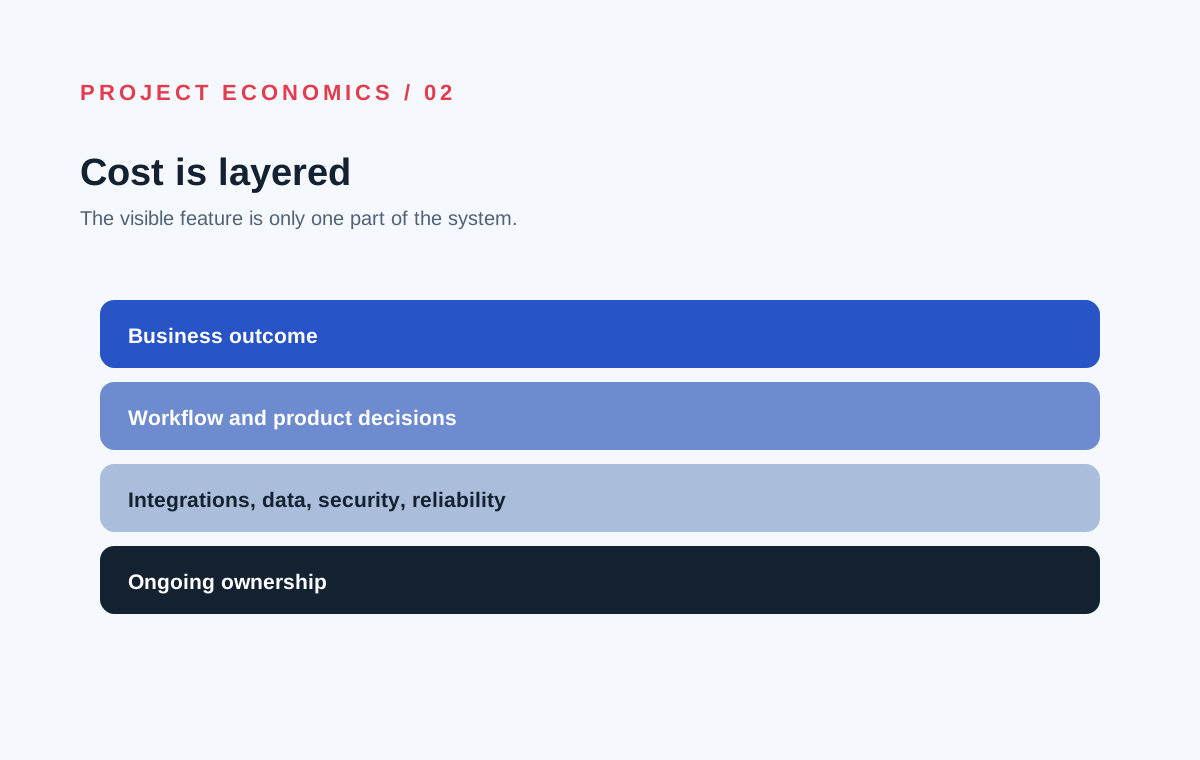
There is no honest single price for custom software before the problem, users, systems, and quality expectations are understood.
A useful estimate is not just a number. It explains what is included, what is uncertain, what assumptions were made, and what could change the cost. This guide shows how to think about the investment without getting distracted by a headline day rate or a technology list.
The short answer
Custom software cost is mainly shaped by five things:
- The number and complexity of business workflows.
- The systems and data the software must connect to.
- The quality requirements: security, reliability, performance, and auditability.
- The amount of product design, discovery, and decision-making required.
- The level of ongoing support and change the business expects after launch.
The fastest way to improve an estimate is to reduce uncertainty before building. That means describing the business outcome, mapping the current workflow, identifying system boundaries, and defining what a useful first release must prove.
Why feature counts are a poor estimate
“Twenty screens” sounds more precise than it is. One screen may be a simple record view. Another may involve permissions, calculations, payments, integrations, background jobs, audit history, and failure recovery.
The visible interface is only one part of the system. Cost also lives in the rules underneath it.
For example, an order screen may need to:
- Validate stock availability.
- Apply customer-specific pricing.
- Reserve inventory.
- Authorise payment.
- Send a fulfilment request.
- Handle a timeout or duplicate request.
- Record what happened for finance and support teams.
That is why a reliable estimate considers behaviour and system interactions, not just pages and buttons.
The main cost drivers
1. Workflow complexity
Simple create-and-update records are usually easier than workflows with approvals, exceptions, multiple roles, deadlines, or changing states.
Ask how many paths exist when something goes wrong. The “happy path” is rarely the full product.
2. Integrations
Connecting to a documented modern API is different from connecting to an old system with inconsistent data, limited access, or unreliable responses.
Every integration needs decisions about data ownership, retries, authentication, rate limits, monitoring, and what happens when one system is unavailable.
3. Data migration
Moving data is not simply copying rows from one database to another. The team needs to understand old formats, duplicates, missing values, relationships, history, and the rules that make a record meaningful.
4. Quality requirements
Security, performance, uptime, backups, audit trails, accessibility, and recovery all affect the design and delivery effort. They should be discussed as business requirements, not added as an afterthought.
5. Uncertainty
Projects with unclear ownership, undocumented legacy behaviour, or unresolved product decisions carry more discovery and iteration cost. That does not mean they should not be built. It means the uncertainty should be made visible.
Three kinds of project cost
Discovery cost
Discovery clarifies the workflow, users, scope, architecture, risks, and first delivery slice. It is an investment in reducing expensive rework.
Delivery cost
Delivery includes design, engineering, testing, integration, deployment, documentation, and the coordination needed to make the system usable in the real operation.
Ownership cost
After launch, the system still needs monitoring, security updates, backups, incident response, maintenance, and changes as the business evolves.
Ignoring ownership produces an artificially low project estimate and an expensive surprise later.
Build an estimate in layers
Instead of asking for one large fixed number, ask for a layered plan:
| Layer | Question it answers | | --- | --- | | Outcome | What business problem will change? | | First release | What is the smallest useful production capability? | | Foundations | What data, permissions, integrations, and reliability work is required? | | Expansion | What can wait until the first release is proven? | | Ownership | How will the system be operated and improved? |
This approach gives the business a decision point before committing to every future feature.
What makes a first release sensible?
A first release should not be a thin demo that avoids the difficult parts. It should be a focused slice of the real workflow that can be used, tested, and evaluated.
For an operational system, that may mean supporting one complete process from request to outcome. For a customer product, it may mean one valuable journey with the right security, data, and support foundations.
The first release should answer: “Does this change the business in the way we expected?”
Questions to ask before accepting an estimate
- What assumptions is the estimate based on?
- Which integrations have been investigated and which are still unknown?
- What is included in testing and deployment?
- How are security, permissions, backups, and monitoring handled?
- What happens when a third-party system fails?
- Which decisions does the client need to make?
- What is the first useful production release?
- What is excluded?
- What will ongoing ownership require?
An estimate that cannot answer these questions is probably describing effort, not the actual project.
Final recommendation
Do not choose a software partner because they gave the lowest early number. Choose the proposal that makes the most important assumptions visible and gives you a credible path from uncertainty to a working system.
At SystemVale, we help businesses turn an unclear software idea or operational bottleneck into a scoped, technically grounded plan before delivery begins.
Frequently asked questions
Can you provide a fixed price immediately?
Sometimes, when the scope and technical environment are already clear. For complex workflows, a short discovery phase usually produces a more useful estimate than guessing from a brief description.
Is an MVP always cheaper?
An MVP is cheaper only when it is deliberately scoped. Removing important quality or operational requirements can create a prototype, not a viable first product.
What is usually underestimated?
Integrations, data migration, permissions, edge cases, testing, deployment, and post-launch support are commonly underestimated because they are less visible than the user interface.
How can we control cost?
Focus the first release, make decisions early, keep system boundaries clear, and validate the highest-risk workflow before expanding the scope.
A useful next step
Good software decisions start with the workflow, not the feature list.
See how we workNext step
Get clarity before you commit to a software budget.
We can help turn your business requirements into a realistic first release, delivery plan, and cost model.
Plan your software project